What Makes Botox Look Natural
Natural-looking Botox isn't about erasing every line. It's about understanding how your face moves, and knowing which movement to preserve. Dr. Adams breaks down what actually makes results look natural.

Natural-looking Botox is not the absence of movement. It is not a perfectly still forehead, an expressionless photograph, or proof that every line has been erased. And despite what before-and-after photos may suggest, it is rarely the product of a single injection point. Natural Botox is more nuanced. It is the result of understanding how a face moves and knowing which parts of that movement should remain and which should not.
A Face Is Not a Formula
There are familiar landmarks on every face. The brows, forehead, eyes, cheeks and mouth present a beautiful canvas. The anatomy is recognizable, but the way each face moves is entirely unique to each person. One person may raise one eyebrow more than the other. Another may rely heavily on the muscles between the brows when concentrating. Some people may smile first with their eyes. Others use nearly every muscle in the upper face just to tell a story. These differences are subtle, but they matter. Natural-looking treatment cannot begin with a standard number of units placed into a standard pattern. It begins by watching. How do the brows lift? Where does the forehead fold? Which muscles dominate? Where is movement balanced? Where is it already uneven? The face at rest only tells part of the story. The face in motion tells the rest.
The Goal Is Not to Treat Everything
A face without any movement can look treated precisely because it no longer behaves as it should. We recognize expression, even when we are not consciously looking for it. A slight lift of the brow signals curiosity. Movement around the eyes makes a smile feel genuine. Small asymmetries give a face character. Natural Botox aims to respect those details. That does not mean every patient wants the same amount of movement. Some prefer a smoother, more polished result. Others want only the faintest softening. Neither is inherently more natural than the other and neither is right or wrong. The most important question is whether the result feels intentional and whether it still feels like the person wearing it. At STILL, we think of movement as something to refine, not just remove.
Placement Changes Everything
Botox does not simply soften lines. It changes the balance between muscles. Some facial muscles lift. Others pull downward. Some work together, while others oppose one another. Treating one muscle can subtly affect the way a neighboring area moves. That is why placement matters just as much as quantity. A few millimeters can influence the shape of a brow, the openness of the eyes, or the way the forehead moves. More product is not always better, and fewer units are not automatically more natural. The right dose in the wrong place is still the wrong treatment. Natural results come from understanding how each injection contributes to the face as a whole.
Restraint Is a Clinical Decision
Restraint is often mistaken for simply using less product. But thoughtful restraint is not about being too shy with treatment. It's about knowing where treatment adds value and where it does not. Sometimes the most sophisticated choice is to leave a small line alone. Sometimes a stronger muscle needs an adequate dose to create a balanced result. Sometimes treating an additional area would make the face smoother but less expressive. The art lies in recognizing the difference. Natural treatment is not measured by how little Botox was used. It is measured by how appropriately it was used.
Your History Matters, Too
A face carries more than anatomy. It carries habits, preferences, previous treatments, and expectations. Maybe you loved the longevity of your last treatment but felt that your brows became too heavy. Maybe one area wore off earlier than the others. Maybe you want a more noticeable result this time or maybe you want less of one. These details help shape the next treatment. Natural-looking Botox is rarely created by ignoring what came before. It evolves through careful observation, honest conversation, and adjustments made with purpose. This is also why a two-week refinement can be valuable. Once the treatment has settled, the face shows us how it responded. If a small adjustment is clinically appropriate, it can be made based on the actual result rather than prediction alone. Refinement is not an admission that the treatment failed. It is part of treating a living, moving face with precision.
Natural Is Personal
The word natural is used constantly in aesthetics, but it does not mean exactly the same thing to everyone. For one patient, natural means looking rested while keeping plenty of expression. For another, it means a smooth forehead with carefully preserved brow movement. Someone else may want friends to notice that they look unusually good without being able to identify why. There is no single setting called natural botox. That is why the consultation matters. Words like soft, smooth, subtle, and still can mean different things until they are translated into a treatment plan. The best results begin when the patient and provider are looking toward the same result.
The Treatment Should Belong to You
The most natural Botox does not announce itself. It does not replace your expressions with someone else's or force your face into a passing trend. It simply quiets what feels distracting while preserving what feels like you. That takes more than product. It takes an understanding of anatomy, an eye for balance, careful dosing, and enough restraint to recognize when the work is finished. At STILL Studios, we do not treat from a formula. We study the face in front of us. We study it at rest, in motion, and as part of the person who lives in it. Your face was never meant to look like everyone else's. It was meant to look like you. Only refined.
Medically reviewed by Elizabeth Adams, MD. Last reviewed: September 2026.
Other recent
articles.
The Case for a Second Look
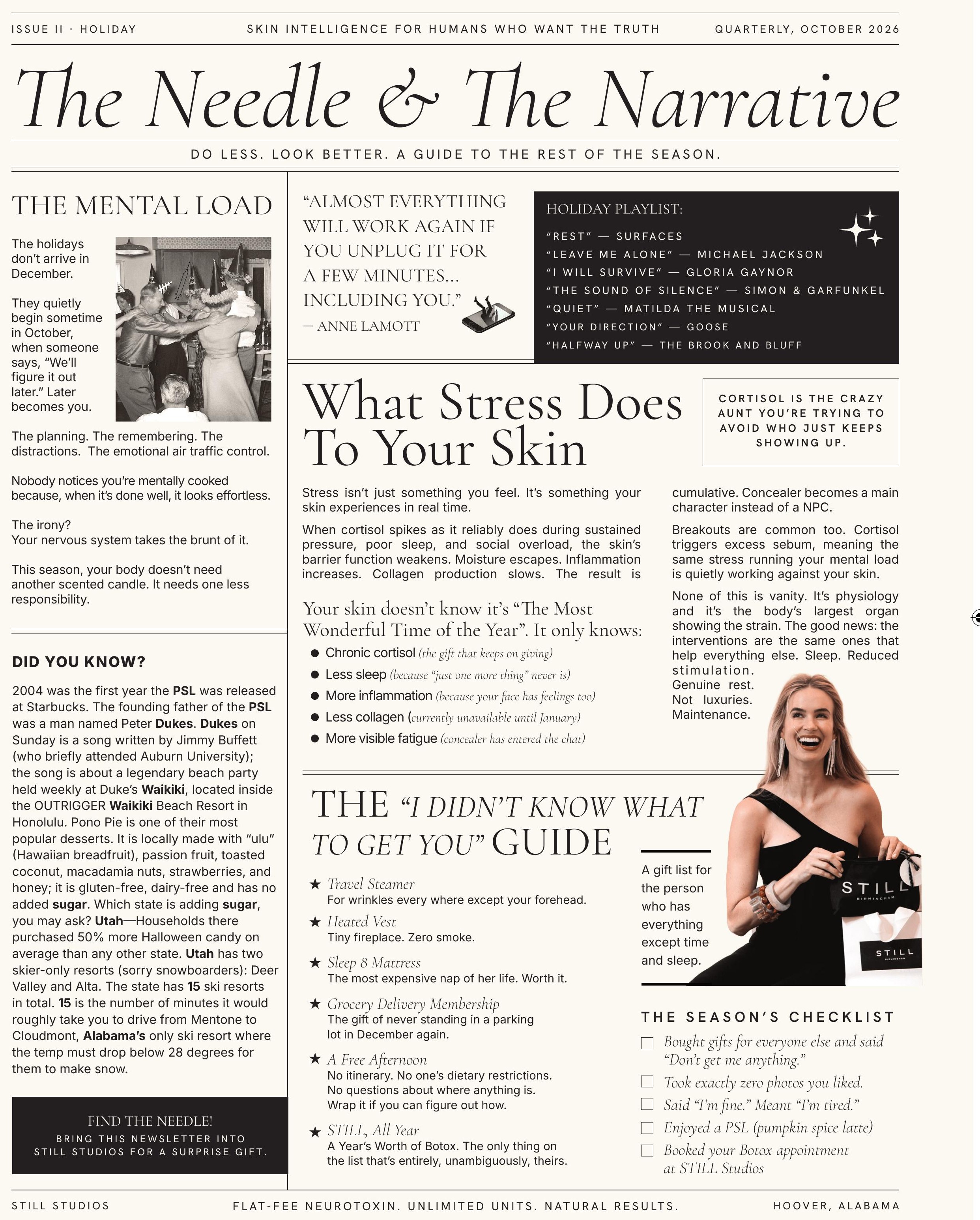
The Needle & The Narrative — Issue 02: The Holiday Guide
Be STILL.
Be You.
Flat rate. Unlimited units. Consultation day of treatment. No waiting. Just done.
Join us in taking neurotoxins beyond the injection room